



Most solar advice on the internet is written for boats in Florida. Applied to a mooring on the North East coast in February, it produces some very disappointed customers.
Solar genuinely works here. It's the single easiest way to stop coming down to a flat battery, and for a boat that sits unused for weeks at a time it more or less solves the problem. But it works differently at 55° north than it does in the Med, and being straight about that up front makes for a much better installation.
What solar is actually for
There are two quite different jobs people ask solar to do, and they need very different sizing.
Job one: keeping a battery topped up. The boat sits on a mooring or in the yard. Nothing much is drawing power except a bilge pump on standby and the slow self-discharge of the battery itself. You want to come back in three weeks and find everything as you left it.
This is the easy one. A modest panel does it comfortably, all year round, and it's the job solar does best.
Job two: running the boat off-grid. Fridge, instruments, lighting, charging phones, maybe an autopilot. You want to sit at anchor for a few days without running the engine.
This is a much bigger ask and needs honest arithmetic — add up what everything actually draws, over how many hours, and size from there. It's also the one where UK seasonality bites hardest.
The seasonal reality
The output difference between June and December in northern England is not a modest dip. It's dramatic — a combination of far fewer daylight hours, a much lower sun angle, and considerably more cloud.
The practical implication: a system sized to cover your consumption in midsummer will not cover it in midwinter, and no amount of optimism changes that. Size for the season you actually use the boat, and plan for shore power or engine charging outside it.
This is also why solar and wind pair well in this part of the world — they tend to be strong at opposite times of year. A Rutland 913 12V wind charger alongside a panel covers a lot more of the calendar than either does alone.
Shading matters more than you'd think
A solar panel is only as good as its worst-shaded section. On a sailing boat that means the boom, the sprayhood, halyards, and the rigging all matter — and a shadow falling across a panel can knock its output down far more than the shaded fraction would suggest.
Which is why on many boats a smaller panel in genuinely clear space outperforms a larger one tucked somewhere convenient but shadowed. Think about where the shadows fall at different times of day before you decide where it goes.
Fixed or fold-up?
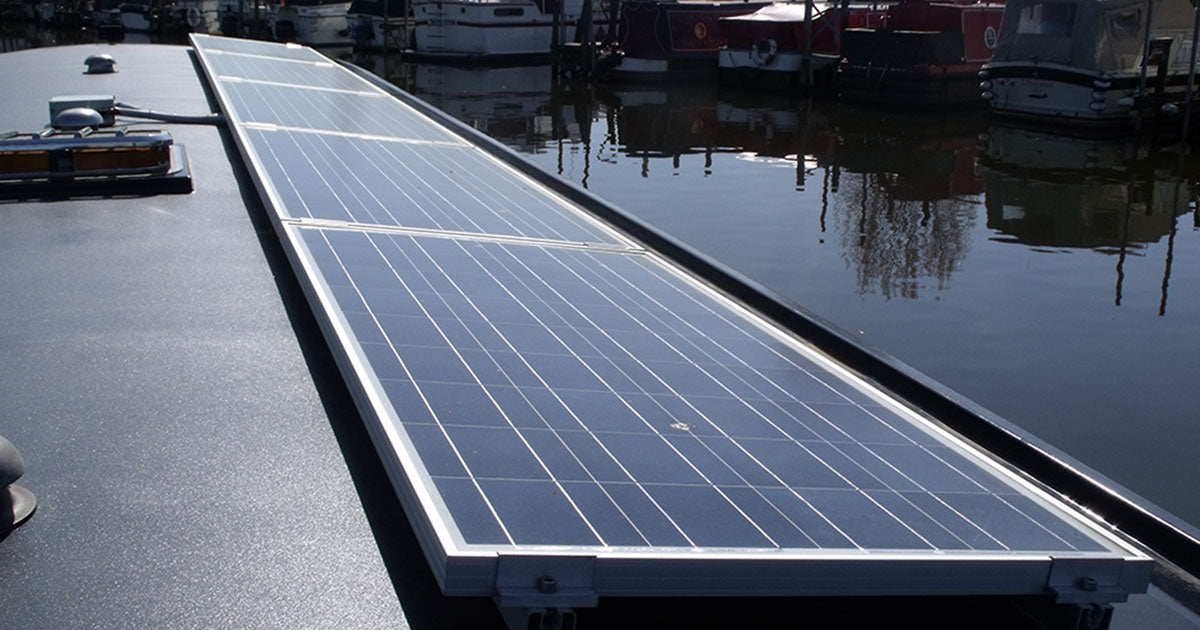
Fold-up panels suit boats where there's no good permanent home for a panel, or where you'd rather not have one on show. You deploy it when you're aboard or when the boat's laid up, and stow it otherwise. It's also the flexible option if you use the panel for other things — camping, the caravan, a van conversion.
Fixed panels suit boats with a natural mounting spot — a bimini, a pushpit frame, a coachroof — and the advantage is that they work whether you remembered to set them up or not, which for a mooring-kept boat is the whole point.
Our fold-up range spans the sensible sizes: 90W for battery maintenance and light duty, 200W as the general-purpose choice for a boat with real but modest consumption, and 440W for genuine off-grid living aboard. All three come with a charge controller included, which brings us to the part people skip.
Don't skip the charge controller
A solar panel connected directly to a battery is a good way to ruin the battery. The controller is what regulates the charge, prevents overcharging, and stops the panel quietly draining the battery back through itself overnight.
The two types you'll see are PWM and MPPT. PWM is simpler and cheaper and is perfectly adequate for smaller installations — it's what comes bundled with our fold-up kits. MPPT is more sophisticated and extracts noticeably more from the same panel, particularly in the weak, low-angle light we get for a good chunk of the year. On a larger array it's usually worth the difference.
One thing to check specifically: if you've moved to lithium, your controller needs to support a lithium charge profile. Same principle as your mains charger. A controller set up for lead-acid won't charge a LiFePO4 bank correctly.
For compact installations, the Spectra Spectralite panel is a neat, low-profile option.
The short version
For most boats on a mooring, a modest panel and a decent controller will end the flat-battery problem permanently, and it's one of the cheapest genuine improvements you can make.
For anything more ambitious, do the arithmetic on your actual consumption first, and be realistic about the time of year you'll be using it. We're happy to work through the numbers with you — bring a list of what's on the boat and roughly how long each thing runs.
Marine Chandlery, Unit G4 Narvik Way, Tyne Tunnel Trading Estate, North Shields.